Introduction
For my project, I decided to look at the antagonists in major films from the 1980s until today to see whether they reflect trends in the things that Americans fear. I originally wanted to analyze the films holistically in order to see how they reflect American values, fears, and beliefs as a whole, but I thought it was too broad and would leave me overextended. I created a list of films created between 1980 and today––one for each year. The criteria for choice was box office success and rotten tomatoes rating. Essentially, I chose the highest grossing film from each year with at least an 80% rotten tomatoes rating. There are two exceptions: Top Gun and Independence Day. For those years, no film met the criteria, so I chose what I believed to be the most fitting.
I have always loved film, and so has the rest of America. Since its inception, film has always been an integral part of our lives, and our perhaps our favorite way to consume stories. The basic hypothesis that my project is built upon, is that the films we love reflect the conflicts we are struggling with in our own lives. Perhaps I can use my project to predict where the film industry is headed in the near future, as I’m sure the Coronavirus will have an impact on the subjects of films to come, either directly or indirectly.
My method of analysis is creating many network visuals. I compiled multiple edge list that connect important villains (or antagonists) through attributes such as: character archetype, origin of evil, distinctive color, association, and decade. Viewers can make inferences based on the similarities and difference between the antagonists of each decade. Since my project is exploratory in nature, I am not necessarily trying to argue anything. I tried to maintain objectivity when creating my edge list, making sure to not concede any bit of truth in order to create connections. I also intended on doing a textual analysis of each film, but I realized would take too long.
I had a lot of difficulty creating my edge and attribute lists. I didn’t quite understand how Gephi processes information, so my first attempt at creating a visual left me with a ton of unlabeled nodes, along with a plethora of different issues. I initially tried to connect the characters to their attributes, but my current visuals connect characters to other characters, via attributes. My second attempt at recreating my edge lists was unsuccessful as well. I thought I only had to create each connection once, which would have worked if I didn’t sort the nodes by degree. In order to remedy this, I had to make each connection go both ways. Other issues I had were coming up with attribute categories that were both broad enough to have commonality between characters and specific enough for the connection to be useful.
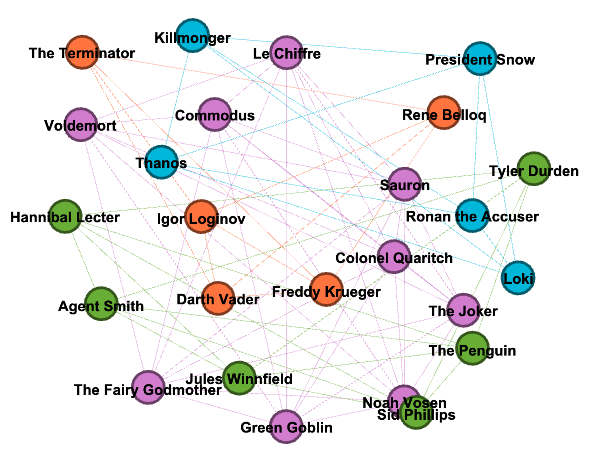
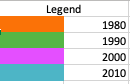
Although I did not find clear-cut trends in the characters I analyzed, I did uncover some common thematic elements. All decades had characters who’s distinctive color was black. On the other hand, the color red was common predominantly in the 80s, while purple was found mostly in the 2000s. During the 80s, America’s main enemy was the USSR, who’s distinctive color is red. The color purple is often associated with royalty and authority, which goes back to the fact that it is the most expensive pigment, but that’s a side note. Perhaps the popularity of purple among villains reflects American distrust towards our own government. This idea is reaffirmed in the association visual, in which” anti-establishment” and “corruption” commonly associated with villains from the 2000s and on. Have we come to fear power itself, seeing it as universally corrupting?
If I ever have the time to continue with my project, I want to include a topic modeling analysis of every script through Voyant. I think it would be interesting to see whether some of the findings from my network analysis would fit in with the overall themes found in the scripts. The general consensus, thematically, is that films from the 1980s were less substantive and had less dynamic characters. These characters, especially the protagonist, were clear-cut good people. The 90s began a shift towards more morally ambiguous heroes as well as addressing more troubling topics. This shift aligns with the idea of the establishment becoming the enemy, because as people begin to question their authority, they begin to question the opinions, values, and beliefs they possess.
Villains by Decade
Archetype
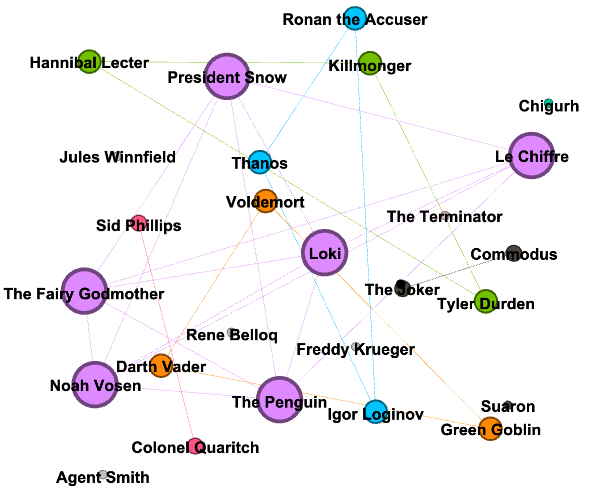
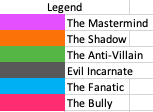
Not all villains are the same, which is what I tried to show here. Each category is different. Shadow is very similar to the protagonist, evil incarnate is pure evil. The anti-villain is a villain one finds themself sympathizing with. The fanatic is driven by a radical ideology, and the bully serves to torment the protagonist.
Distinctive Color
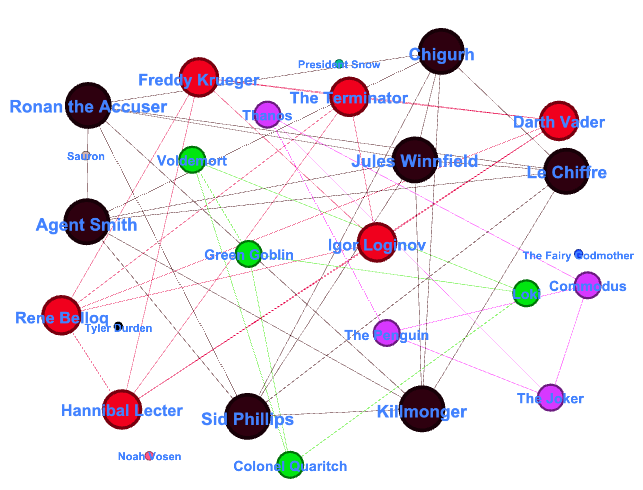
Colors can have a lot of associations. In the 80s, the predominant color was red, which aligns with America’s primary fear at the time: the USSR. As we arrive in the 2000s, the color purple is often associated with villains. Since purple is a very expensive pigment, members of royalty or high authority have generally been the only to wear it. Thus, purple is associated with authority and power. So, perhaps, after the fall of the Soviet Union, America’s main fear became the establishment. Without communism to fight, American’s may have come to question if our own system of government is really so perfect.
Origin of Evil
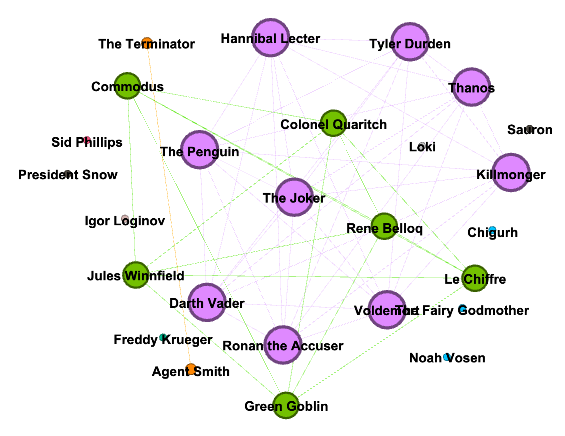
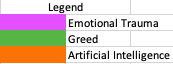
Most villains come from either emotional trauma or simply greed. There is no real trend to observe here, except that often the best villains come from severe emotional trauma, such as losing one or more family members. The hero often experiences the same thing, except for they turn their grief into a positive thing, instead of using it to justify performing evil acts.
Associated Real-World Fear
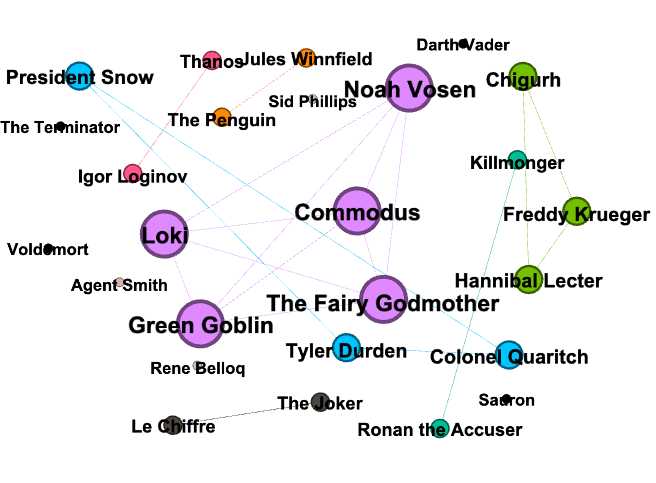
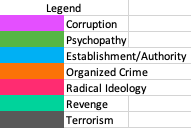
Many of the villains on this list were associated with corruption, being initially good, then swayed to the dark side by either anger or greed. This suggests that what Americans–and people in general–fear is the fragility of our own moral integrity. These villains while being fictional, reflect what happens in the real world. People are corrupted, by radical ideology, by desire for money, fame, and by anger. We often like to create an us-vs them dynamic to separate ourselves from those we view as evil, but in the end, we are all the same, and can be swayed by the same motivations as the villains in these films. What we fear the most, is that the people we trust the most, including ourselves, will become the very villains that we fear.
Works Consulted
Dauenhauer, Janette, et al. Information Analysis of Movie Genres –
Drexel University. 2014,
http://cluster.ischool.drexel.edu/~cchen/courses/INFO633/13-14/mammarelli.pdf.
Herr, Bruce W, et al. Author’s Personal Copy – IU. 2007.
https://cns.iu.edu/docs/publications/2007-herr-movieact.pdf
Bioglio, Livio, and Ruggero G. Pensa. “Identification of Key Films and
Personalities in the History of Cinema from a Western Perspective.” Applied
Network Science, Springer International Publishing, 30 Nov. 2018,
https://appliednetsci.springeropen.com/articles/10.1007/s41109-018-0105-0#Tab2.
